Showing posts with label TH: Culture. Show all posts

Friday

Hair Rules - example in Jamaican and in English school


In every culture and society, some things you are socially and culturally allowed to do with your hair, and other things you are not. These rules are not always explicit, but in workplaces and schools they are sometimes part of the internal regulations.

Here the link (click) to an article from the Jamaican writer Kei Miller's blog, about a controversy in a Jamaican school (2016), explaining why, in the particular context of Jamaica, it is more that just a haircut we are talking about: Yes, this is about slavery and its long legacy. It is about a full emancipation that has been so desperately long in coming. 
Read also Corey Hairstory (click)  about natural hair at school and the difference of reception between a Jamaican school and New York one.

In 2018, a court decision in Jamaica clears the way for dreadlocked child to start school (links here).
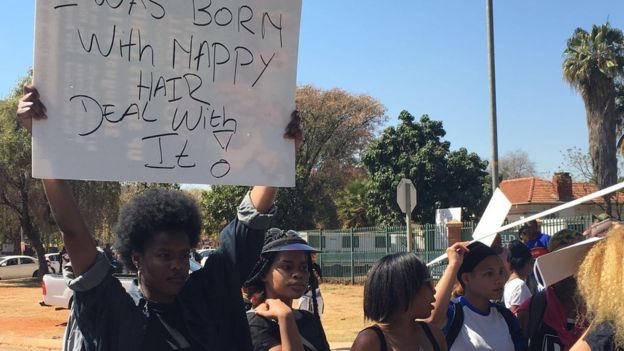
(Photo from Kei Miller's blog)
And here the link (click) to an article about haircuts that are not allowed in different schools in England (2017 - with a remember of olds days:
Aged 17, David Bowie campaigned for long-haired boys rights in his Brixton Schoolboy (photo Getty)


Hair Sculptor: Laetitia Ky

Laetitia Ky (Ivory Coast) transform hair in masterpieces speaking about body positivity, gender equality, environment, gun violence,... and celebrating African heritage.
A short video about her work here
(image from Laetitia Ky Instagram)


Wednesday

Hair! Human Stories - Exhibition

Tabitha Moses, Hairpurse, 2004

From intimate personal stories, to unexpectedly global tales about hair’s circulation around the world, Hair! Human Stories explores our curious relationship to hair. Encounter strange artworks made from hair, see images of hair harvests and wig manufacture past and present, and learn about hair’s recycling possibilities.

Curated by Emma Tarlo, anthropologist and author of Entanglement: The Secret Lives of Hair, the exhibition invites you to confront hair – the original human fibre.

7 – 26th June 2018
The Library Space 
London

Monday

I-D's Hair Week: 60's articles about Hair !

I-D present her Hair Week like “an exploration of how our hairstyles start conversations about identity, culture and the times we live in”. 
Yes! 
They do the job of this blog, speaking about gender, races, identity, culture through songs, films, music, video, art, hair stories… from around the world (mainly western)

You can consult all the articles here on their Website but here already a few links among the sixty articles

Willow Smith - "Whip My Hair


Science: What is Hair? 


Huffingtonpost “blog” - Black Hair


Articles about black hair, mostly natural hair (perception, tips, cultural appropriation, story,…) by black women mostly


#Culture #Politique #Genre 
#BlackHair
#Press #Web
#US #BlackComunity

Sunday

Hair Jewellery

Hair is the first ornament of both woman and man. Hair has always been an ornamental object by itself, as well as a basic material used in finery. This is true for all times, in societies as diverse as the Bororo of Brazil or the Victorian English society.

Earrings with human hair -  Victorian period - England


Monday

Evolution of Hairstyle


100 years of beauty: Japan (Mey)

Clips showing different looks from 1910 to 2010, by country.
All the clips are visible here, I selected the following:

Syria and a critic of this clip here in the New Arab blog

Note that these clips are made by an american crew. Some of them attract a lot and diverse reactions (read the comments). 

#History #Culture #Society #Gender
#Short Documentary

Saturday

Good Hair by Chris Rock


About black hair culture and its different significations and implications (social, political, cultural, economical). About extensions, relaxer, wigs, natural hair,…
A serious subject treated with humor.

#Society #Economy #Culture #Politic 
#BlackHair #Extension #Wig #Straight #Relaxer
#Documentary
#US #BlackComunity

Friday

Me, My Hair, and I by Elizabeth Benedict

Me, My Hair, and I
twenty-seven women untangle an obsession
by Elizabeth Benedict

(2015 - Algonquin Books)

These twenty-seven "hair pieces" offer up reflections and revelations about family, race, religion, ritual, culture, motherhood, politics, celebrity, what goes on in African American kitchens and at Hindu Bengali weddings, alongside stories about the influence of Jackie Kennedy, Lena Horne, Farrah Fawcett, and the Grateful Dead. Layered into these essays you'll find surprises, insights, hilarity, and the resonance of common experience. Marita Golden writes about her grief over what so many African American women still endure to obtain "good hair." Patricia Volk itemizes her seventeen hair care products, each with a price tag. Myla Goldberg tells of how ill equipped she was to tend the hair of her adopted biracial daughter. And Suleika Jaouad describes the ravages of chemotherapy and the empowerment of shaving designs onto her head. Source : http://www.goodreads.com/book/show/24001099-me-my-hair-and-i

#Culture #Religion #Politics #Society
#Hair Story
#Book

Alicia Brown: art and hair


Characters, 2016, oil on canvas.

Alicia Brown (°1981) is a Jamaican practicing fine artist and art educator.
Hair is one of the elements she uses in her oil painting to question Caribbean identity and the impact on it of social construct, colonialism, mass media, pop culture, Western trends.

See more of her work HERE (click).

#Identity #Culture #Society
#Visual Art #Painting
#Jamaica

Thursday

Sharon Norwood: art an hair

Sharon Norwood is a multi-disciplinary artist, working in both 2D paintings and 3D ceramics.  Born in Kingston Jamaica, she studied in Canada and the United States, receiving her Bachelors of Fine Arts Degree from the University of South Florida.

She uses hair in her works to explore different thematics: identity, politics, history, culture ...
See more of her work HERE (click) her website, Facebook, Instagram


Split Ends: Unfamiliar Landscape, fired decals on vintage porcelain, 2014
The Root of the Matter III, digital collage on paper, 2016


#Identity #Society #Culture 
#Visual Art
#BlackHair
#Jamaica 

Trichologiques (An anthropology of the hair and body hair) in French - Christian Bromberger

Trichologiques
Une anthropologie des Cheveux et des poils
(An anthropology of the hair and body hair)
Christian Bromberger
(Bayard, 2010)

The author relies on his own ethnographic surveys (in Iran, in the Mediterranean countries, in Hokkaido, in the cancer department of a hospital ...) and on a considerable documentation that includes all continent and period of The story, Christian Bromberger tells his various encounters with hair. Hair offers singular properties to symbolize the differences between the sexes, between the social statuses, between Neighboring or distant populations but also between submissive and insubordinate, between the order of the monastery and the wandering of the hermit, between the civilized and the savage …

#Culture #Society #History #Religion #Symbolism #Gender
#Book

Wednesday

Hair - Cheveux (English vs French)

/'heə/ /ʃəˈvø/


In English the word "hair" designates the hair on the head as well as that on the rest of the body, for both humans and animals. In French different words are used: “cheveux” for hair on the head, “poils” for hair everywhere else on the human body, as well as for the hair on animals.


In English, the word "hair" is always singular, whereas in French it is plural (except when speaking about 1 strand of hair).

For some idioms in English and French, read below... 

by Alex Latimer

#Culture #Language

Hair Story from Charlotte: Tired of the stereotypes

Charlotte had long dreads. She eventually cut them entirely, tired of the stereotypes into which people tried to lock her, as well as of the many police controls she had to undergo. To keep her dreadlocks, she made a wig out of them.

Charlotte, 30 's, Female, Belgium 
#Culture #Stereoptype
#Wig #Dreadlocks

Hair Story from Véronique

Whereas my hair (long natural brown hair) can provoke sometimes reactions in some parts of the world (people touching it, asking me if it’s mine, mentioning the fact that some of it is turning white), my partner’s dreadlocks nearly always provokes reactions, wherever we are, even in our home country (Belgium). From simple curiosity (which can go quite far sometimes: in Cuba, a woman set up a whole scheme trying to take a picture of herself with my partner, without him being aware of it) over fear and near panic (in Burkina Faso, at a time where he loosened his hair, some people got very frightened), to straight rejection (in Turkey a number of men came to explain, repeatedly and not always very kindly, that men really couldn’t not wear long hair) and systematic police or custom control, wherever we goes. 
Here in Jamaica, where people in the street are called by their most visible characteristic, I’m called « Whitie », whereas my partner is called « Rasta », his hair (and what it could means here) apparently being a more important trait than his skin color.

Véronique, 40’s, Female, Belgium-Jamaica 
#Culture #CulturalPerception  #Gender #Stereotype 
#Dreadlock

Hair Story from Marvette

My Jamaican niece lives in China. She wears dreadlocks. She says that people stop to ask her to touch her dreads and take pictures. There are not many blacks in China but it is not the color that intrigues them, it is her hair.
Marvette, 55’s, Female, Jamaica
#Culture #CulturalEncounter #Dreadlock

Hair Story from Omar

I’ve had dreadlocks of various length for more than 20 years, but I practice zen, so am not attached to them :)
While I could happily have short or no hair, I feel like my hair is a kind of connection to the more beautiful aspects of Jamaica and it's culture (call it livity) - and also enjoy not having to think about haircuts or styling :) 
Omar, 40, Male, Jamaica 
#Culture #SymbolLivity #Dreadlock #Easy 

Hair Story by C.

I have smooth blonde hair. During my travels in different African countries, I often feel aggressed when, out of curiosity, people come to touch my hair (even if I can understand this curiosity). This always gives me the impression to be a freak.
C., 40, Female, Belgium 
#Culture #CulturalEncounter #Blonde 

Hair Story from Neila

For at least 22 years I have shaved my head, scraped off my 'good, curly, mixed-people hair' down to the scalp, with no more than 1/2 inch of fuzz left. It is glorious and freeing everytime. With every haircut I release the societal pressures for long, straight hair which equals maximum 'feminine' power and I reject expectations of me as a mixed heritage girl, to play my 'hair privilege' card. It is easy and gives me a different sense of self and confidence. I dance differently, with greater abandon and swear my sense receptors open also. Spiritually, my head becomes like an antenna and I have to box away hands from randomly touching my spiritual seal. My hair story changes, though, when I miss movement and rhythm around my head, the vibrancy of my curls (which I did not always appreciate, having been taught to envy the white girl straight hair which seemed to signal the ultimate freedom), the militancy, individuality and rebelliousness of my locs, the urban funkiness of hair colour, braids, canerows and my signature mohawk. For a while, I grow it and experiment with this acceptance and celebration of self, knowing that when I need a clearing, a reset, a newness, I will pull out my shears and bless myself with a new head. 
Neila, 30's, Female, Jamaica
#Identity #SocialPressure #Gender #Culture #HairReset

Hair story from Soueloum

It is said that hair is the first adornment of women.
The continuity of energy coming maybe from the sky.
Where I come from we say that when a man pulls a tuft of hair of his wife, this is grounds for divorce.
A married woman cannot cut her hair.
During her menstrual period, a woman doesn’t dress her hair
After delivery, it takes forty days before a woman takes care of her hair.
For major festivities women let their hair exposed to the open air during forty-eight hours, before braiding it.
It is said that "to know the mood of a woman, look at her hair and its health."
A woman who makes her prayers is not allowed to have her hair out in the open air. 
Soueloum, 60’s, Male, Tuareg of Mali
#Culture #Society #Religion #FirstAdornment #CulturePractice